
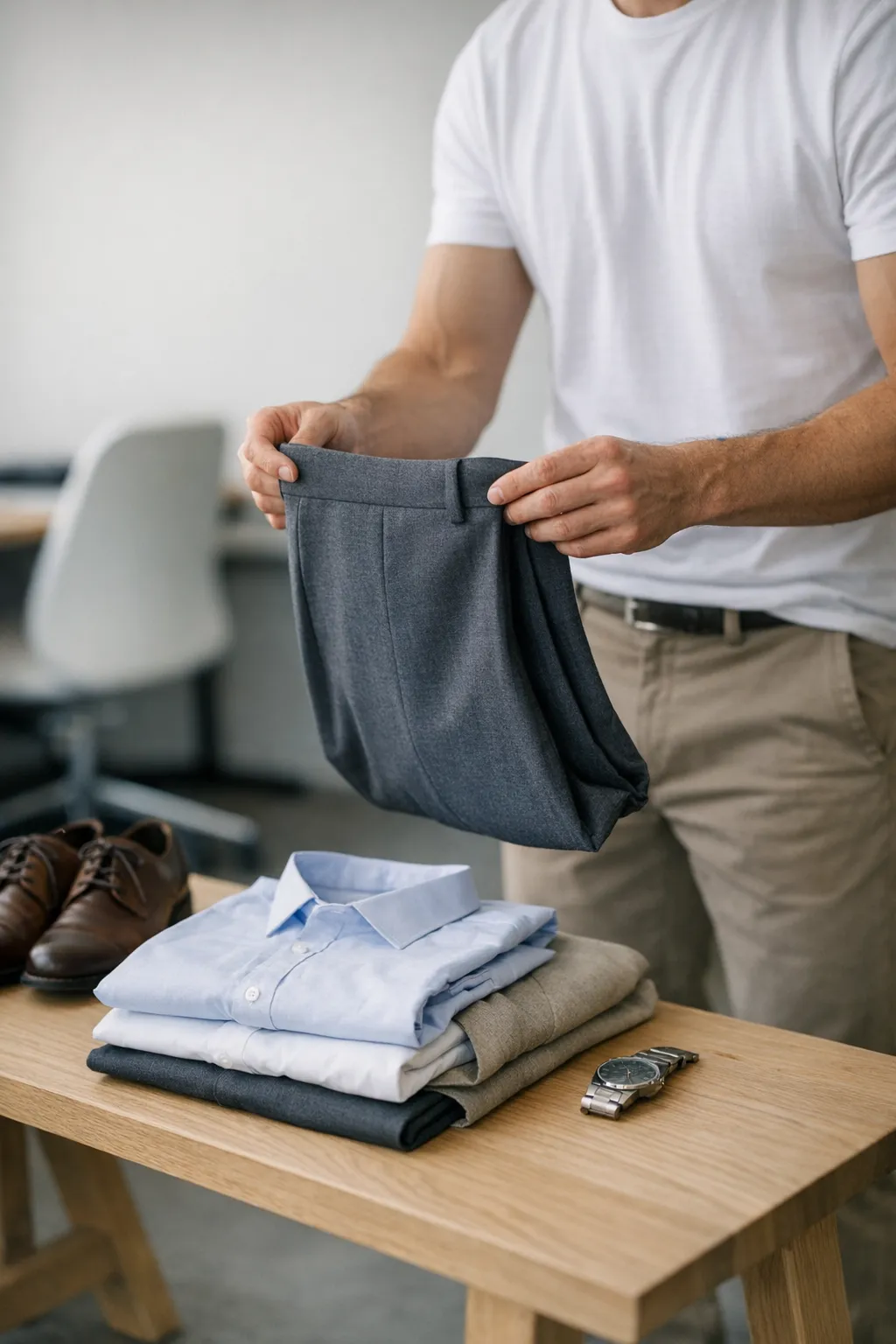
In a tech office, the sharpest men's outfits are built on a short list of well-fitted basics rather than a wardrobe full of options. The dress code sits at the relaxed end of business casual, but that does not mean anything goes. Fit is the single most important variable, as Style Masterclass notes that a cheap shirt that fits well reads better than an expensive one that is baggy and shapeless. A practical starting point is clean chinos or tailored trousers, a fitted button-up or structured sweater, and a pair of loafers or minimal leather shoes. Neutral colors like navy, grey, olive, and white keep everything easy to combine. Brands like LESH offer pleated trousers and long-sleeve shirts in exactly these tones, making it straightforward to build a coherent base without overcomplicating the process.
Building a Tech Office Wardrobe That Actually Works
What are the core pieces every man needs for a tech office?
A functional tech office wardrobe does not require a large collection, it requires the right pieces in colors that work together. Style Masterclass recommends a 20-piece starter wardrobe as a practical minimum, built around 2 jackets, 10 tops, 1 sweater, 3 pants, 2 pairs of leather shoes, and 1 sneaker. That framework translates cleanly to tech settings, where the goal is flexibility across casual and semi-formal moments without maintaining a separate wardrobe for each.
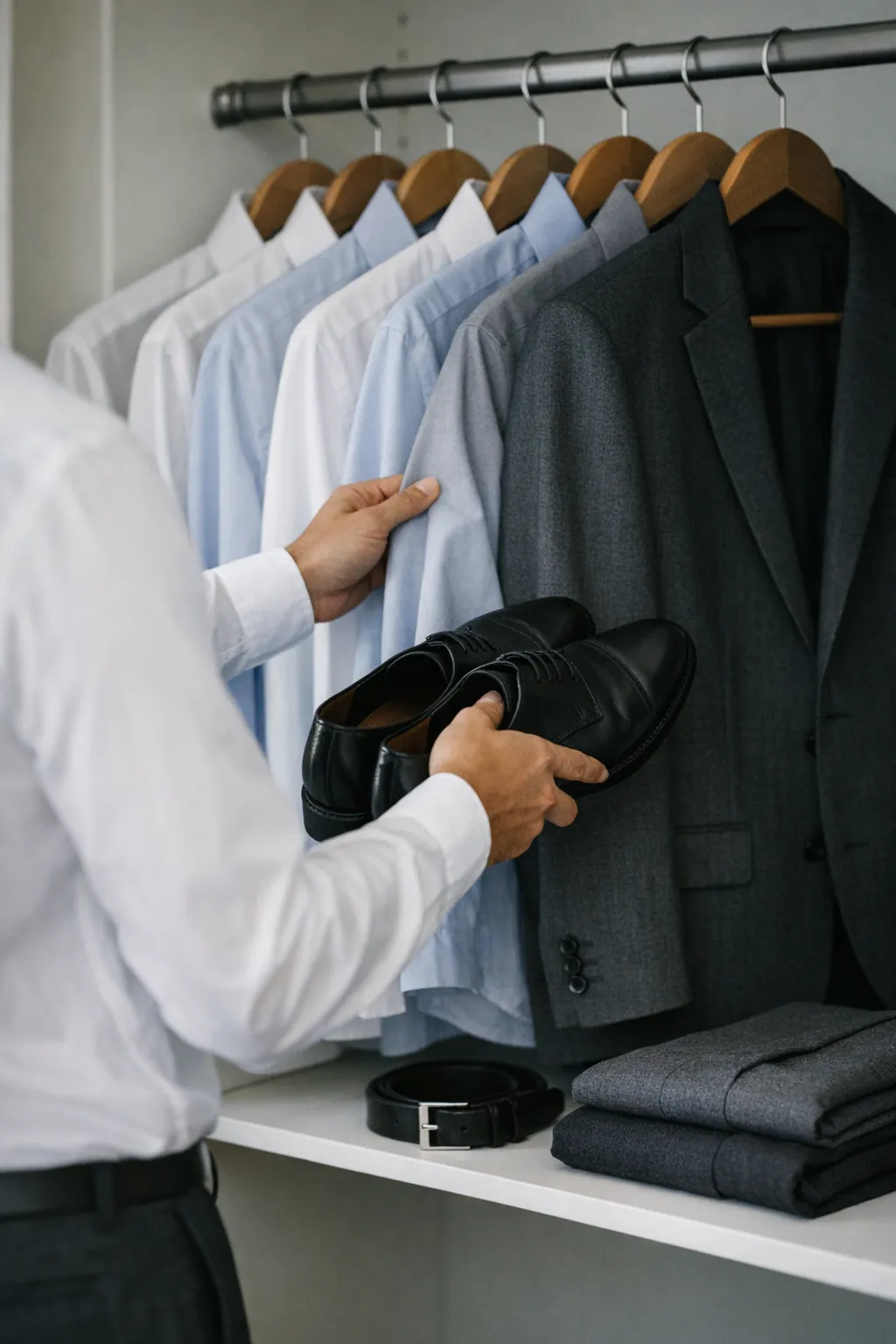
Neutral colors do most of the heavy lifting here. Navy, white, grey, olive, and camel mix easily across all the core pieces, so a morning spent grabbing whatever is clean still produces a coherent outfit. A grey long-sleeve shirt, for example, pairs with tailored trousers, chinos, or even dark denim depending on how relaxed the day calls for, and LESH offers foundational options like their long-sleeve grey shirt that sit comfortably in this kind of rotation.
Shoes anchor the formality level more than most men expect. Loafers work as a versatile base, adding a second leather option like a Chelsea boot gives you enough range to cover everything from a morning standup to an after-work client dinner without changing the rest of the outfit.
How do you use a blazer in a tech office without looking out of place?
The blazer is a calibration tool, not a commitment to formality. Without one, khakis and a plain shirt can read as underdressed, add a structured blazer to the same outfit and you can tip the other direction if the rest of the look is not balanced carefully, as noted in guidance from the Insperity Jobs business casual board.
In a tech environment, an unstructured blazer solves both problems. It signals that you put thought into the outfit without carrying the weight of a suit jacket. A light-colored linen blazer works well for transitional seasons, while a navy or charcoal option covers most year-round scenarios. The key distinction to understand is between a blazer and a sport coat: blazers tend toward cleaner, more uniform fabrics while sport coats lean on texture and pattern, making blazers the more reliable choice for tech offices where the dress code is already loosely defined.
Which fabrics and fits hold up across a full workday?
Fit is the single variable that separates a sharp outfit from a forgettable one, and it matters more than price point or brand. As Jack Archer notes, a well-fitted cheaper shirt reads better than an expensive one that is baggy through the shoulders or boxy through the torso. Shoulders should sit cleanly at the seam, shirts should skim the body without pulling, and trousers should break naturally at the shoe rather than bunching at the ankle.
Performance fabrics that resist wrinkles and hold their shape through movement are worth prioritizing for full-day wear. Soft oxford cloth and lightweight poplin work well for button-ups, for trousers, a structured fabric with some stretch maintains a clean line whether you are sitting through a long meeting or moving between floors. Fit does vary across brands and cuts, so checking a brand's individual size guide and reviewing their exchange policy before purchasing is worth the few extra minutes.
Tailored or pleated trousers in a neutral tone like grey or beige are among the most reliable tech office bottoms because they read as intentional without requiring a blazer to justify them. The pleated trousers in beige from LESH are a practical example of a piece that works across multiple outfit configurations without needing much around it.
What small details separate a polished tech office look from a forgettable one?
Details do more work in casual dressing than in formal dressing because there are fewer structural elements carrying the look. TheGetup's styling segments consistently emphasize that paying attention to small choices, fit, fabric quality, and accessory restraint, elevates a business casual outfit more reliably than adding more pieces.
A practical framework from Style Masterclass is worth applying here: more details on a garment make it read more casual, more color makes it read more casual, and trendier silhouettes make it read more casual. In a tech office, leaning into clean, simple pieces in muted tones and letting one considered detail, a good watch, a leather bag, or a quality pair of shoes, carry the personality of the outfit tends to produce the sharpest results. Accessories do not need to be numerous to be effective, the LESH accessories collection reflects that same restraint-first approach.
What the Research and Style Guides Say
- GQ Magazine states that "the best business casual clothes are the best clothes, period," framing quality and fit as the foundation of any office wardrobe rather than adherence to a specific dress code (source URL not available in original material, attributed to GQ Magazine).
- A curated Pinterest board of 100 business casual outfit pins assembled by Insperity Jobs has remained a reference point for men's office styling for nearly 9 years, reflecting the enduring consistency of core wardrobe principles (source URL not available in original material, attributed to Insperity Jobs).
- Style Masterclass recommends a 20-piece starter wardrobe as a practical minimum for men navigating business casual dress codes, published January 2025 (source URL not available in original material, attributed to Style Masterclass).
- Within that 20-piece framework, Style Masterclass specifies 2 jackets, 10 tops, 1 sweater, 3 pants, 2 pairs of leather shoes, and 1 sneaker as the core allocation for a functional, mix-and-match wardrobe (source URL not available in original material, attributed to Style Masterclass).
- Style Masterclass advises starting with 4 ties in neutral colors and simple patterns as a minimal entry point into business accessories without overloading the wardrobe (source URL not available in original material, attributed to Style Masterclass).
- Neat Apparel's rotation guidance, published December 30, 2025, recommends building around a small set of reliable shirts, two solid pant options, and one versatile layer to reduce daily decision fatigue and maintain consistency (source URL not available in original material, attributed to Neat Apparel).
- Jack Archer identifies five distinct workplace scenarios that each require adapted outfit approaches: the creative workplace, finance and law, the home office, a cocktail party, and a business trip, published 2026.
- Jack Archer notes that fit matters more than price point, stating that a well-fitted inexpensive shirt reads more professionally than an expensive one that is baggy or poorly proportioned, published 2026 (source: Jack Archer ).
- TheGetup's visual guides distinguish a blazer from a sport coat by silhouette and fabric weight, a distinction that directly affects how formal or casual a business casual outfit reads in any workplace setting (source URL not available in original material, attributed to TheGetup).
Frequently Asked Questions
What exactly counts as business casual in a tech office?
Business casual in a tech office means looking polished and intentional without the structure of a suit. It sits at the relaxed end of the professional spectrum, typically covering tailored chinos or trousers, a fitted shirt or sweater, and clean leather shoes or minimal sneakers. The practical benchmark, as Style Masterclass notes, is to observe what leaders and senior colleagues wear and calibrate from there rather than applying a fixed universal rule.
Are chinos or khakis appropriate for a tech office, and do they need a blazer?
Chinos and khakis are appropriate for most tech offices, but the styling around them determines how the outfit reads. Worn alone with a plain shirt, they can appear underdressed, the Insperity Jobs business casual board specifically notes that khakis without a jacket risk looking intern-level. A clean polo, structured sweater, or unstructured blazer rebalances the look. For a more tailored alternative to standard chinos, pleated trousers in grey offer a sharper silhouette with similar versatility.
What is the difference between a blazer and a sport coat, and does it matter in tech?
A blazer and a sport coat differ primarily in fabric and silhouette. Blazers use cleaner, more uniform fabrics and tend to read as more polished, while sport coats lean on texture, pattern, and a slightly more relaxed construction. In most tech offices the distinction matters less than fit and color, but understanding it helps when deciding how formal a layer needs to be. A solid navy or charcoal blazer covers the majority of tech office scenarios reliably.
Can a grey cable knit sweater work as a business casual piece in a tech environment?
Yes, a grey cable knit sweater is one of the more versatile business casual options for a tech office. The Insperity Jobs business casual board highlights it as a strong pairing with classic pieces precisely because it adds visual texture and warmth without reading as either too formal or too casual. Worn over a white or light blue shirt with tailored trousers and loafers, it covers most tech office scenarios from daily standups through end-of-day meetings.
Which colors work best for building a minimal, professional tech office wardrobe?
Navy, white, grey, olive, and camel are the most reliable starting colors for a tech office wardrobe, per Style Masterclass guidance. These neutral tones mix easily across all core pieces, meaning a small rotation of shirts, trousers, and a jacket produces a wide range of coherent outfits without careful planning. Loud or highly saturated colors require more precision to pull off and are generally better introduced as accents once the neutral base is established.
How do I avoid looking overdressed when everyone around me is dressed very casually?
The most effective approach is to stay polished through fit and fabric rather than through formal garments. An unstructured blazer, a well-fitted long-sleeve shirt, and clean trousers read as intentional without signaling that you misread the room. Jack Archer suggests reading the unwritten dress code by observing what leaders wear and adjusting by one level rather than matching the most casual person in the office. Browsing the LESH collection offers a useful reference for what understated, well-proportioned pieces actually look like in practice.